
Featured














Version 3 of the EEA's Resilience Guide, published in December 2025, significantly expands on its predecessor — introducing new risk categories, stronger governance expectations, and deeper integration with asset management decision-making. Asset Dynamics' Andrew Gatland outlines what has changed and what it means for New Zealand's electrical infrastructure owners.
Andrew Gatland and Kate Ivicheva of Asseterra Limited argue in the Institute of Directors' Boardroom Magazine that asset governance has become a critical board-level responsibility. The article outlines the questions directors should be asking, and how linking organisational purpose to asset performance can provide greater assurance and confidence.
Auckland Transport and Asset Dynamics presented a peer-reviewed paper at New Zealand's Transportation Conference in March 2026. The paper drew on Auckland Transport's ten-year journey in enhancing its asset management capabilities, highlighting the importance of strategic asset management in getting the most from limited resources.
Asset Dynamics' Andrew Gatland has been awarded the Certified Fellow in Asset Management (CFAM) designation under the World Partners in Asset Management Global Certification Scheme. The CFAM is one of the most prestigious international recognitions in the field, awarded to those who demonstrate strategic technical leadership and deep expertise in asset management.
In our new article, co-authored by Dr Sophia Elizabeth Fourie and Dr Jules Congalton, we break down why valuing asset management data is challenging, how updated ISO 55001:2024 standards are reframing data value and provide practical frameworks for valuing data.
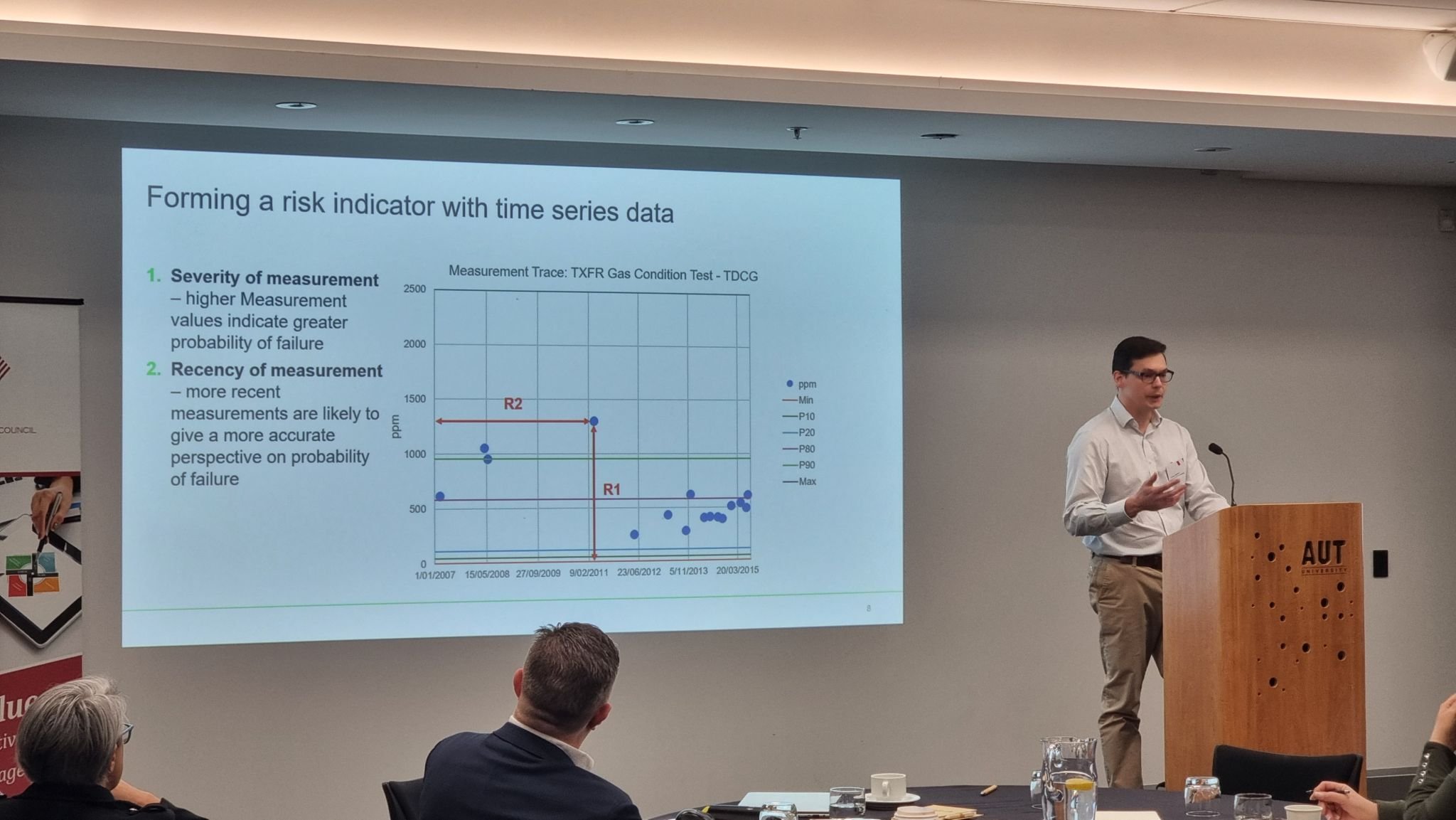
Asset Dynamics' Andrew Gatland presented at the Asset Management Council New Zealand Chapter Symposium 2025, arguing that infrastructure owners can do more to realise value from data already held in their asset management information systems. The paper, co-developed with Dr. Jules Congalton and Dr. Bob Platfoot of Covaris, presented three case studies demonstrating practical approaches to unlocking that value.
Digital twins are virtual models of real assets that can help organisations run and maintain infrastructure more effectively. A new standard (ISO/IEC 30186) gives clear, independent guidance to make sure they deliver real value and keep improving over time. This article summarises how digital twin maturity assessments can help New Zealand’s asset intensive and infrastructure organisations.
Asset Dynamics and Covaris presented a joint paper at the EEA Conference in Christchurch in September 2025, sharing three case studies showing how electricity infrastructure organisations can extract greater value from data already held in their asset management systems. The full paper and slides are available to download.
Artificial intelligence (AI) is rapidly transforming the management of asset information across the energy sector. In this article we explore the implications of AI for how asset information is collected, managed, and used.
Asset Dynamics marks three years since its establishment in May 2022. In that time the firm has supported close to thirty infrastructure organisations across electricity, transport, gas, ports, and local government — developed and launched the DataFrame data health platform, contributed more than ten peer-reviewed papers and presentations to the asset management profession, and been engaged by Āpōpō to support its learning and development programmes. A look back at the journey and forward to what comes next.
Asset Dynamics and Auckland Transport presented a finalist paper at Āpōpō Congress 2025, making the case for infrastructure organisations developing a clear, canonical description of their asset management system. The paper draws on Auckland Transport's journey as a practical case study in how this approach can consolidate asset management systems and lift organisational maturity.
Information Disclosure regulation places significant demands on utility businesses, and errors carry real penalty risk. Asset Dynamics' Andrew Gatland and Jules Congalton outline a proven methodology for managing disclosure obligations efficiently — linking information requirements directly to asset management systems and applying automated data quality checks year-round.
In this article Asset Dynamics’ Jules Congalton outlines how to understand which data is most valuable for asset intensive organisations by using asset management value frameworks.
The New Zealand Infrastructure Commission has recommended that major infrastructure providers undertake independently verified asset management maturity assessments — but assessments only deliver value when the right framework, assessor, and internal process are in place. Asset Dynamics' Andrew Gatland outlines how to get the most from your next assessment.
Local Water Done Well will bring about transformative change in how water services are provided in New Zealand. But the water sector is just one part of the infrastructure deficit the country is facing. This article considers what needs to change to enable to New Zealand to become a global leader in realising value from our infrastructure assets.
ISO 55013:2024 formally establishes that data can be recognised and managed as an organisational asset — bringing data into the same management framework as physical assets. Asset Dynamics' Andrew Gatland and Jules Congalton provide an overview of the standard and its implications for how infrastructure organisations manage data in support of asset management.
The claim that an organisation has implemented 'best practice' asset management is common across New Zealand's infrastructure sector. Asset Dynamics Director Andrew Gatland examines why that claim is rarely substantiated, whether context-independent best practices even exist, and what a more honest and effective approach to asset management improvement looks like.
ISO 55001, the international standard for asset management systems, was updated in 2024 for the first time in ten years. Asset Dynamics Director Andrew Gatland summarises the key changes — including new requirements for decision-making frameworks, strategic asset management planning, data and information management, knowledge management, and predictive action — and what they mean for infrastructure organisations.
Asset Dynamics and ProjectMax delivered a three-part webinar series to help water services operators build a 'least regrets' pathway through Local Water Done Well reforms. Covering levels of service, asset management frameworks, and data and information management, recordings and slides from all three sessions are available to download.
Learn how to get the best from your asset data and information in this webinar presented by Jules Congalton of Asset Dynamics on 6 December 2023.
Wildfire risk is increasing across New Zealand, and electricity distributors face the challenge of managing thousands of network assets in fire-prone conditions. This article outlines a structured approach to wildfire risk management — linking asset data directly to risk model requirements and using data quality monitoring to provide assurance that models can be relied upon.
What are New Zealand infrastructure leaders’ seeking to understand with respect to asset information governance? Learn more in this article that responds to five key questions posed by attendees at the EEA 2023 conference.
As at August 2023, ten New Zealand organisations had achieved ISO 55001 certification across five sectors. Asset Dynamics examines certification data, electricity distribution AMP disclosures, and local government planning documents to assess how widely the ISO 55000 standards are being used across New Zealand's infrastructure sector.
At the Electricity Engineers’ Conference held during June 2023 in Ōtautahi Christchurch, Asset Dynamics’ Jules Congalton presented on the vital importance of information governance for infrastructure asset management. Full paper available.
Asset Dynamics partnered with Top Energy, the electricity distributor for the Far North, to implement DataFrame — Asset Dynamics' data health monitoring platform. Read about the engagement, what Top Energy's CIO had to say, and how a Callaghan Innovation grant supported the next stage of DataFrame's development.
Low confidence in the accuracy of asset information is a common issue for asset managers who are charged with using it to make decisions that have far-reaching consequences for customers and other stakeholders. At the Electricity Engineers’ Association Conference 2023, Asset Dynamics presented a paper on how improving asset information governance can deliver long-term value for infrastructure organisations.
Asset Dynamics developed DataFrame to address a critical gap in infrastructure asset management — the absence of structured, real-time visibility over data health. DataFrame links an organisation's operating model to its data model, enabling asset and information teams to identify, prioritise, and resolve data quality issues before they affect decision-making.
Asset Dynamics supported Unison Contracting Services Limited in the development and consolidation of its quality management system, culminating in ISO 9001 certification in December 2022. Read about the engagement and what UCSL's Performance Manager had to say about working with Asset Dynamics.
Asset Dynamics Director Jules Congalton led the development of the EEA Asset Information Maturity Framework as part of the EEA's Asset Information Managers' Forum. This article introduces the framework — its four capability areas, five maturity levels, and how electricity distribution businesses can apply it to improve asset information governance and data quality.