
Getting real value from Asset Management Maturity Assessments

New Zealand cannot afford to build its way out of its infrastructure challenges. As Te Waihanga New Zealand Infrastructure Commission identified in its late-2024 report Taking Care of Tomorrow Today: Asset Management State of Play, closing the infrastructure gap through capital investment alone would cost an estimated $31 billion per year, almost twice current spending levels. The only viable path is to do more with less. And that demands a genuine uplift in asset management maturity across the sector.
Asset management maturity assessments are one of the most powerful tools available to infrastructure organisations seeking to understand where they stand and what to do next. The Infrastructure Commission agrees: its Key Recommendation 3 calls for all public major infrastructure providers to periodically undertake independently verified maturity assessments and publicly report the results.
“Require all public major infrastructure providers to periodically undertake an independently verified asset management maturity assessment and publicly report on the results.”
But commissioning a maturity assessment is not the same as realising value from one. In our work at Asset Dynamics, we regularly encounter organisations where a thorough assessment has been completed, findings noted and then quietly filed. Months later, little has changed.
This article sets out what maturity assessments are for, what limits their effectiveness, how to select the right framework and assessor, and, critically, what the organisation itself must do to translate findings into action.
What is asset management maturity?
Asset management is a strategic business capability, comparable to financial management or human resources, that exists to help an organisation realise maximum value from its assets over multiple time horizons. The more capable the organisation is in asset management, the more likely it is to deliver on that value.
The Global Forum on Maintenance and Asset Management (GFMAM) defines asset management maturity as:
“The extent to which the capabilities, performance and ongoing assurance of an organisation are fit for purpose to meet the current and future needs of its stakeholders, including the ability of an organisation to foresee and respond to its operating context.”
A maturity assessment is therefore not a compliance exercise. Its purpose is to provide objective, structured feedback on whether the organisation’s capabilities are fit for purpose today and positioned to meet future requirements, and whether those capabilities are actually delivering required performance.
Selecting the right assessment framework
The choice of assessment framework matters. It shapes the questions asked, the evidence gathered, and the recommendations that follow. Because you will ideally use the same framework across successive assessments (to track improvement over time), this is a decision worth making deliberately.
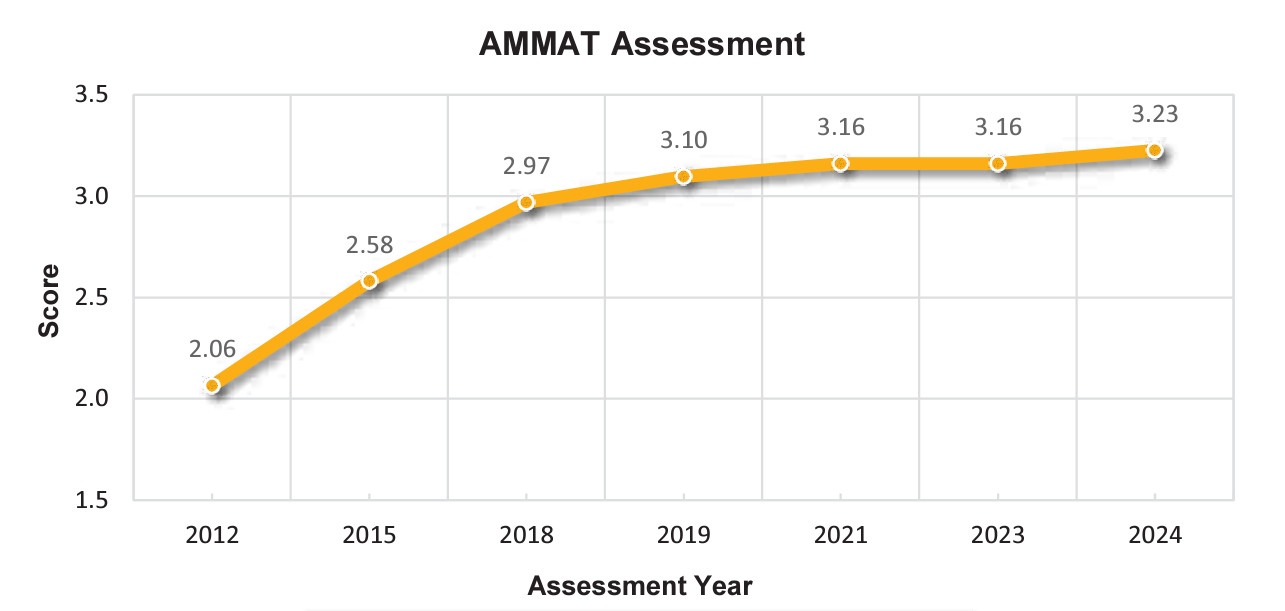
Unison Networks’ successive assessments against the Commerce Commissions Asset Management Maturity Assessment Tool (AMMAT)
The Institute of Asset Management’s Maturity Scale and Guidance offers a useful way to think about this. Its ‘bow tie’ diagram describes two phases of maturity development. On the left, organisations converge toward a common standard, most naturally represented by conformance with ISO 55001. On the right, mature organisations diverge as they develop capability tailored to their own context.
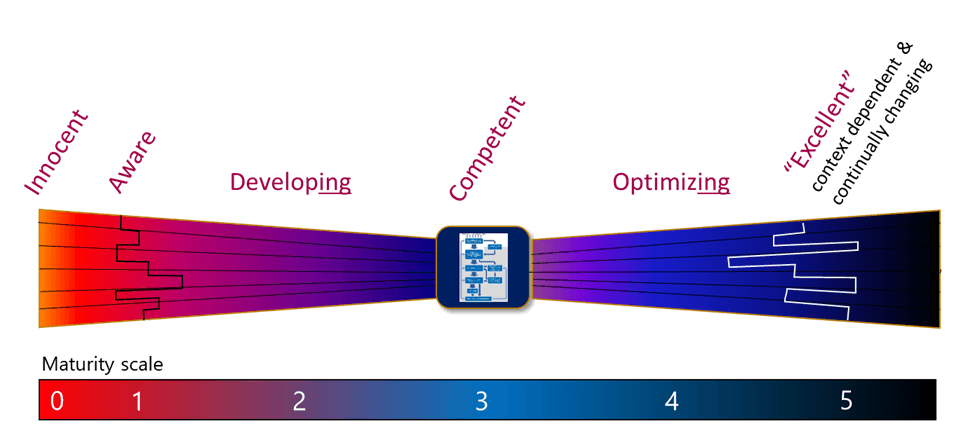
Institute of Asset Management Maturity Scale and Guidance
This has a practical implication: standard frameworks are most appropriate for organisations in the earlier stages of capability development. For organisations that already conform with ISO 55001, a more customised or peer-benchmarked approach is likely to generate more useful insight.
Given the Infrastructure Commission’s finding that maturity levels across New Zealand’s infrastructure sector are generally low, most organisations will benefit from working with established standard frameworks. The main options in New Zealand include:
Commerce Commission’s Asset Management Maturity Assessment Tool (AMMAT), mandatory for electricity distribution businesses under information disclosure requirements
Institute of Asset Management Self-Assessment Methodology Tool (SAM+)
Treasury Investor Confidence Report (ICR) Asset Management Maturity assessment
International Infrastructure Management Manual (IIMM) Asset Management Maturity Framework, widely used in local government
Conformance assessment against ISO 55001 or PAS 55
Proprietary frameworks developed by consultancies, drawing on ISO 55001, the GFMAM Asset Management Landscape, and sector-specific practice
The goals of the assessment should drive framework selection. EDBs have a regulatory obligation to complete and disclose AMMAT self-assessments; an independent assessment aligned to AMMAT criteria provides directly comparable and credible feedback. Local government organisations often benefit from the IIMM framework given its practitioner origins and the peer benchmarking it enables.
One factor worth noting: both ISO 55001 and the GFMAM Asset Management Landscape were updated in 2024, integrating the latest global thinking into these foundational documents. Organisations aspiring to current good practice should consider whether their chosen framework reflects these updates.
Selecting the right assessor
The assessor’s role is to understand the organisation’s goals, gather and analyse evidence against the chosen framework, report findings clearly, and provide recommendations that are genuinely actionable. Delivering an effective assessment requires a demanding combination of competencies.
Technical and sector knowledge
Strong asset management knowledge across the breadth of the discipline is essential: the GFMAM Asset Management Landscape covers 39 subjects across six groups. Relevant sector experience matters too: an assessor who understands how electricity distribution or water infrastructure operates will gather better evidence and generate more useful recommendations. Conversely, experience across multiple sectors can be a genuine advantage, bringing cross-pollination of good practice and, sometimes, the introduction of new knowledge-sharing relationships between organisations.
Audit skills and professional behaviours
Maturity assessment is fundamentally an audit process. ISO 19011 provides the relevant framework. The assessor needs to be competent in conducting interviews, reviewing technical and non-technical documentation, and observing work in practice. Equally important are the professional behaviours ISO 19011 identifies as essential for effective auditors: ethical conduct, open-mindedness, diplomacy, perceptiveness, and adaptability.
The CAMA credential
Certified Asset Management Assessor (CAMA)
The CAMA credential, established by World Partners in Asset Management, recognises broad asset management knowledge and audit competence. It is also the mandatory qualification for all ISO 55001 auditors under the Joint Australian and New Zealand Asset Management Systems Scheme. There are currently 1,485 CAMA-certified professionals globally, including 42 in New Zealand.
When engaging an external assessor, look for evidence of CAMA certification, relevant sector experience, and a track record of delivering assessments whose findings have led to measurable improvement. References from past clients are informative.
What the organisation must do
The assessor’s role ends with the report. What happens next, whether findings are absorbed, endorsed and acted upon, is entirely within the organisation’s control. This is where value is most often lost.
Common failure modes we have observed include:
Senior leadership not engaged in the process, leading to findings being contested or deprioritised after the fact
The organisation lacking the internal knowledge to interpret assessment criteria and feedback
A detailed report overwhelming an organisation without the bandwidth to respond
Recommendations not translated into a funded, tracked improvement programme
The following practices significantly improve the probability that an assessment will lead to meaningful change:
Build internal capability before the assessment begins
The person commissioning and managing the assessment should have a solid grounding in modern asset management thinking. If that grounding doesn’t yet exist, some targeted learning and development is a worthwhile investment. It will improve the quality of the brief to the assessor, the organisation’s ability to engage in interviews, and its ability to critically evaluate findings.
Brief the assessor clearly
Communicate the goals of the assessment, the intended audience for the report, and any contextual factors that should shape how results are framed and recommendations are scoped. Assessors work best when they understand what ‘useful’ looks like for this particular organisation at this particular point in time.
Engage senior management meaningfully
The CEO and senior executive should understand why the assessment is being undertaken, participate in interviews, and attend the closing presentation. Their engagement signals to the rest of the organisation that findings will be taken seriously, and it dramatically increases the likelihood that improvement actions will be resourced and sustained.
Develop an internal response to the report
This is perhaps the most critical step. Rather than forwarding the assessor’s report to senior management and waiting for a reaction, the asset management team should produce a concise internal document that: interprets and contextualises key findings; endorses or respectfully challenges specific recommendations; proposes concrete actions with owners and timeframes; and outlines how delivery will be tracked.
This document does two things. It internalises the assessor’s feedback, translating external observations into organisational language, and it creates a foundation for an Asset Management Roadmap if one does not already exist. Approval by a relevant senior executive gives it the standing it needs to drive change.
Capture lessons for the next assessment
A mature approach to maturity assessment means learning not just from the findings, but from the process. Document what worked well and what could be improved: the brief, the evidence-gathering, the reporting and the internal response, so that successive assessments become more efficient and more valuable.
Conclusion
Asset management maturity assessments can play a meaningful role in improving New Zealand’s infrastructure performance. The Infrastructure Commission is right to identify them as a priority tool, and right to call for independent verification and public disclosure to raise the standard of practice.
But the assessment itself is only the beginning. Organisations that realise lasting value from this investment are those that approach it with a clear purpose, select the right framework and assessor, engage their leadership, and take ownership of translating findings into action.
At Asset Dynamics, we bring CAMA-certified assessors, deep experience in regulated infrastructure, and a practical focus on helping organisations move from insight to improvement. If you’re considering an asset management maturity assessment, whether as a standalone engagement or part of a broader improvement programme, we’d welcome the conversation.
Considering an asset management maturity assessment? Asset Dynamics brings CAMA-certified assessors and deep experience in regulated infrastructure. We'd welcome the conversation.
Get in touch