
Building Resilient Transport Through Strategic Asset Management
Auckland Transport and Asset Dynamics presented a peer-reviewed paper at New Zealand's Transportation Conference on 9 March 2026 in Te Whanganui-a-Tara Wellington. The paper drew on Auckland Transport's ten-year journey in enhancing its asset management capabilities, highlighting the importance of strategic asset management in getting the most from limited resources.
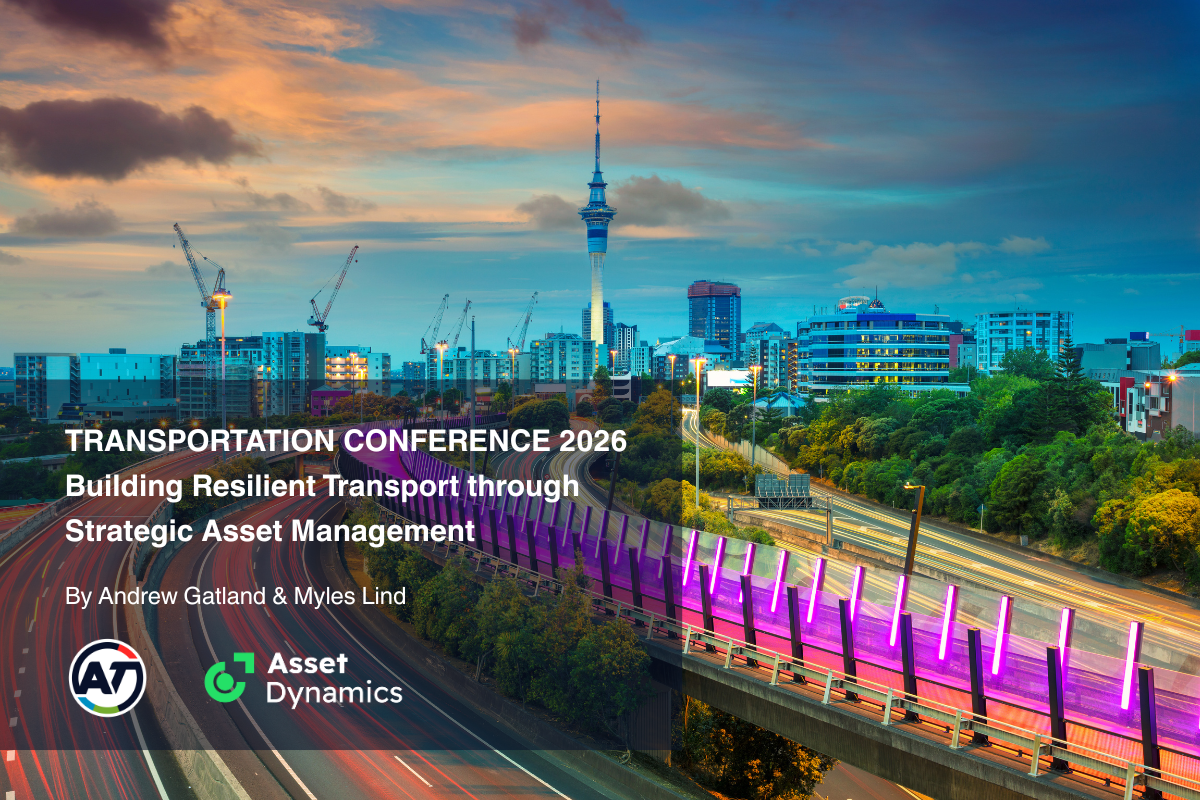
Presented by Auckland Transport's Co-Director Infrastructure and Place and Chief Engineer, Myles Lind, the paper examined the critical role of an Asset Management Framework in enabling organisations to consistently balance cost, risk, and performance. A well-defined framework provides a clear, end-to-end view of how asset management is delivered across an organisation, aligning teams, processes, and systems. It moves asset management from a specialist function to a shared organisational capability.
Drawing on Auckland Transport's ten-year journey, the paper demonstrated how embedding a robust Asset Management Framework aligned with ISO 55001 can improve decision-making, reduce organisational silos, lift maturity, and build investor confidence. Measurable improvements in asset management maturity and organisational alignment show the tangible value of this approach.
The conference itself reinforced the relevance of the topic. Both NZTA and the New Zealand Infrastructure Commission made clear statements about the need for better asset management across the transport sector, signalling that strategic asset management capability is increasingly expected of transport infrastructure organisations.
The Transportation Conference is one of New Zealand's largest transport conferences, jointly presented by Transportation Group New Zealand and Trafinz. This year's theme was "Working with what we have: Resilience for the Future."
The full paper is available on the Asset Dynamics website.
Abstract
New Zealand's transport network is vital to the nation's social and economic prosperity, yet it faces significant challenges including an infrastructure investment deficit, rising costs, climate change adaptation, and workforce constraints. Addressing these issues requires a strategic approach to asset management that optimises limited resources while ensuring resilience and stability in critical transport infrastructure.
Asset management provides a coordinated framework to balance cost, risk, and performance outcomes across stakeholder groups and time horizons. The development of an Asset Management Framework is essential for transport infrastructure organisations to align their teams, processes, and systems effectively. This framework offers a precise, end-to-end description of how good-quality asset management is implemented, enabling organisations to manage risks, improve communication, and foster collaboration across diverse teams.
Auckland Transport's ten-year journey in enhancing its Asset Management Framework demonstrates how such a tool can address resource constraints and infrastructure deficits. By clearly defining the scope, boundaries, and processes of its asset management system, Auckland Transport has improved organisational alignment, reduced silos, and enhanced decision-making. The framework supports resilience by enabling better planning, lifecycle management, and continual improvement, ensuring that infrastructure investments deliver maximum value.
This case study highlights the importance of leveraging limited resources through strategic asset management practices. By embedding a robust framework, transport organisations can mature their systems, manage risks effectively, and build investor confidence, ultimately contributing to a resilient and sustainable transport network for New Zealand's future.
Interested in strategic asset management for transport infrastructure?Asset Dynamics works with transport and infrastructure organisations to develop asset management frameworks, strategy, and capability.
Get in touch